



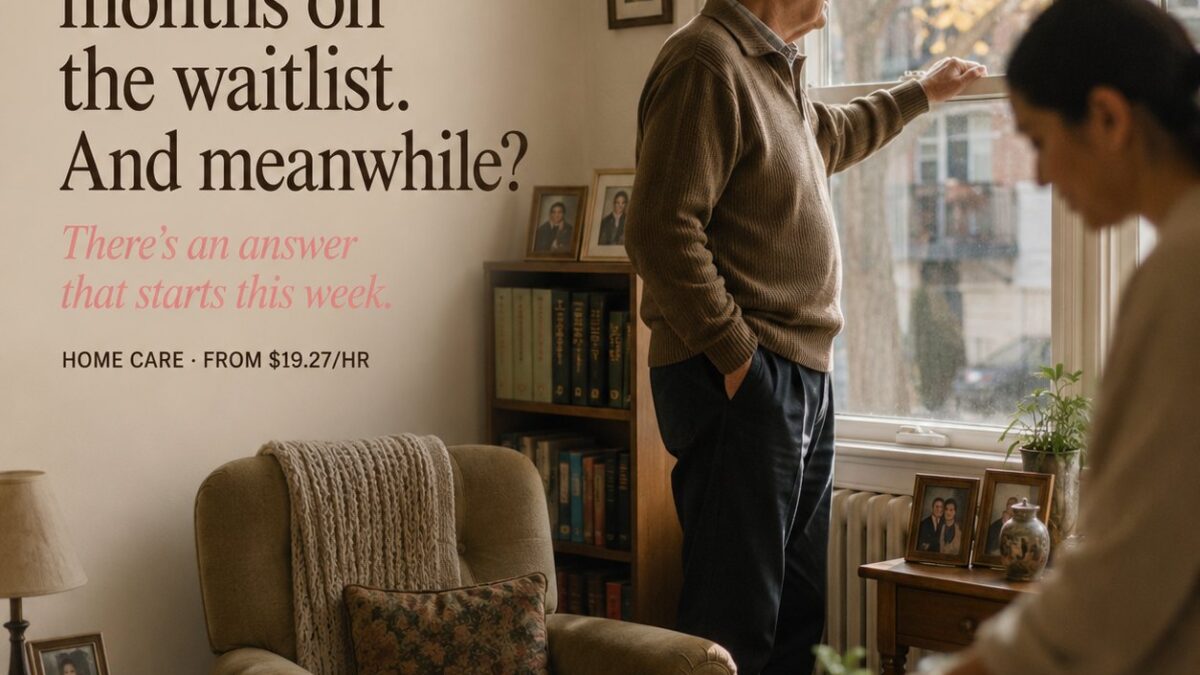
Your parent has been assessed. The file was accepted. You were told “we’ll call you when a spot opens up.” And since then, nothing. This is the stretch nobody prepares you for: the decision is made, but nothing has actually changed at home.
That gap has a measurable length, and it has real options. Here is what you need to know to get through the waiting months without the situation deteriorating in the meantime.
What the CHSLD waiting list actually means
The average wait for a place in a long-term care centre now exceeds seven months in Quebec, according to figures reported by the association representing private conventioned facilities. Depending on the region, it can reach 24 months. In early August 2026, 726 patients were still occupying hospital beds because no accommodation spot was available.
In other words: being accepted onto the CHSLD waiting list is not the end of the problem, it is the beginning of a six-month to two-year period during which your parent stays exactly where they are. And during that time, independence does not improve — it keeps declining.
The question is not “when will the spot come through.” It is “who takes care of my parent until then.”
The three places your parent can live while waiting
There are not four. During the wait, three options exist, and each one has a real cost.
- Stay alone at home with public services. The CLSC provides a limited number of hours, often a few per week. Free, but rarely enough once loss of independence has set in.
- Move into a private seniors’ residence. Expect $1,200 to $3,800 a month for an independent unit depending on the region, and around $4,500 for a unit with care included. One move, followed by a second move to the CHSLD a few months later.
- Keep your parent at home with a caregiver. One person present, in familiar surroundings, with no intermediate uprooting. This is the option whose cost is most widely misunderstood — and often the lowest once Quebec’s financial support is applied.
For comparison, public accommodation is not free either: the maximum monthly contribution ranges from $1,395.30 for a room with three or more beds to $2,242.20 for a private room, indexed every January 1 by the RAMQ.
$19.27 an hour: the starting point for care at home
That is the hourly wage of an elderly caregiver placed through our agency. It is not an estimate — it is what the caregiver receives. Agency fees are added on top, they vary with the arrangement you choose, and they are quoted free of charge. We do not publish a total price, because a full-time live-in caregiver and fifteen hours a week are not comparable things.
We broke that calculation down, financial support included, in our article on what home care for an elderly parent really costs in Quebec.
What Quebec reimburses: 40% in 2026
The refundable tax credit for home-support services for seniors applies to people aged 70 and over. Its rate has risen by one point a year since 2022 and reaches 40% in 2026. Refundable means it is paid even if your parent owes no income tax.
For a single person recognized as non-autonomous, the eligible-expense ceiling is $25,500, which works out to up to $10,200 in credit for the year. The details and calculation tables are published by Revenu Québec.
Two further levers are often available, and few families activate them: the service employment paycheque (chèque emploi-service), through which the CIUSSS funds home-support hours directly, and the SAPA program for support of seniors’ independence. Eligibility depends on the CLSC assessment — the same assessment that put your parent on the list in the first place.
The geographic barrier, and the medical exception that lifts it
To bring a live-in caregiver from abroad, the Temporary Foreign Worker Program imposes a restriction in certain areas of Quebec where the unemployment rate exceeds a set threshold — Montreal, Laval, Gatineau and Brossard among them.
That restriction falls away when there is a documented medical condition or certified loss of independence. In the case of a parent already assessed and waiting for accommodation, the medical file already exists. This is precisely the situation the exception was written for, and it applies everywhere in Quebec. We explain the mechanics on our elderly caregiver page.
One thing worth checking before you commit anywhere: who prepares the file. With us, the LMIA application and the work permit are handled in-house by a lawyer who is a member of the Barreau du Québec, not outsourced to a third party.
How long before she arrives, compared with the CHSLD waiting list
A local caregiver, living out, can start within a few weeks. A live-in caregiver from abroad takes 8 to 9 months in total: job posting, LMIA application, work permit, visa, arrival. That is a long time, and we say so plainly rather than promising better.
But set those 8 to 9 months alongside the seven months to two years of the CHSLD waiting list: both clocks run at the same time. A family that starts both processes in the same month has a caregiver at home before, during or just after the call from the CIUSSS — and keeps the choice. A family that waits for the call first is left with nothing on the day the situation tips over.
If your parent is on the CHSLD waiting list, where to start
- Pull out the CLSC assessment. It is the document that unlocks both the financial support and the medical exception.
- Ask the CIUSSS where the service employment paycheque file stands. Many families have never claimed it.
- Work out the net cost of care at home, with the 40% credit deducted, before comparing it with a private residence.
- Decide between a local caregiver now and a live-in caregiver in 8 to 9 months — or both, in sequence.
We will do that calculation with you over the phone, with no commitment, and we will tell you when care at home is not the right answer for your situation.
Let’s talk about your situation. Tell us where your parent lives, what the CLSC assessment says and how many hours you are covering today. You will get a plan and a free quote, not a brochure.
Request a free quote or call us at (514) 344-0099, Monday to Friday, 9 a.m. to 5 p.m.