



You are 52. Your mother is 81. For six months now you have been dropping by every other day, managing the appointments, sleeping badly. And you have started pricing home care for an elderly parent without once finding a real number — because the real question, the one you never quite say out loud, is: can we actually afford to keep her at home?
It is the question we hear most often. It is also the one families are worst informed about — not for lack of intelligence, but because nobody puts the real numbers on the table. Here is what home care for an elderly parent actually costs in Quebec, government support included, and how that number compares with the alternatives.
The starting point: $19.27 an hour
A live-in caregiver assigned to an older adult earns from $19.27 an hour, depending on the applicable occupational category. That is an employee wage, with everything that comes with it: source deductions, time off, regulated working conditions.
The figure surprises families in both directions. Some expected less and find it high. Others had private hourly nursing-agency rates in mind — often double or triple — and discover that continuous presence costs less than fragmented presence.
On top of the wage come agency fees, which vary with the complexity of the file, the region and the profile sought. We do not publish a single flat package: quoting one fixed price for situations that have nothing in common would be dishonest. The estimate is free and itemized, line by line, before any commitment.
What Quebec reimburses on home care for an elderly parent
This is where most families leave money on the table, simply because nobody told them what exists. Three programs, combinable in several situations.
The tax credit for home-support services for seniors. It applies to people aged 70 and over and covers 40% of eligible expenses, as a refundable credit — paid even when the person owes no income tax. Personal assistance and routine household services qualify. Conditions and ceilings are set out by Revenu Québec.
The service employment paycheque, or chèque emploi-service. Administered by the CIUSSS, it lets a person whose loss of autonomy has been assessed by the public network receive an allowance to hire their caregiver directly. It is the least known of the three and often the most decisive. Access goes through a needs assessment at the local CLSC.
The SAPA program — support for the autonomy of seniors — frames all public home-support services in the province. General information on what is offered is available on Québec.ca.
Once the tax credit is applied, what a family actually pays bears little resemblance to the gross figure they started from. That is the calculation almost nobody runs before giving up on the idea.
The other two options, in numbers
An honest comparison means looking at the alternatives without dressing them up.
- A private seniors’ residence — from $1,800 to over $7,000 a month depending on the region, the size of the apartment and the level of service included. Additional care is frequently billed separately.
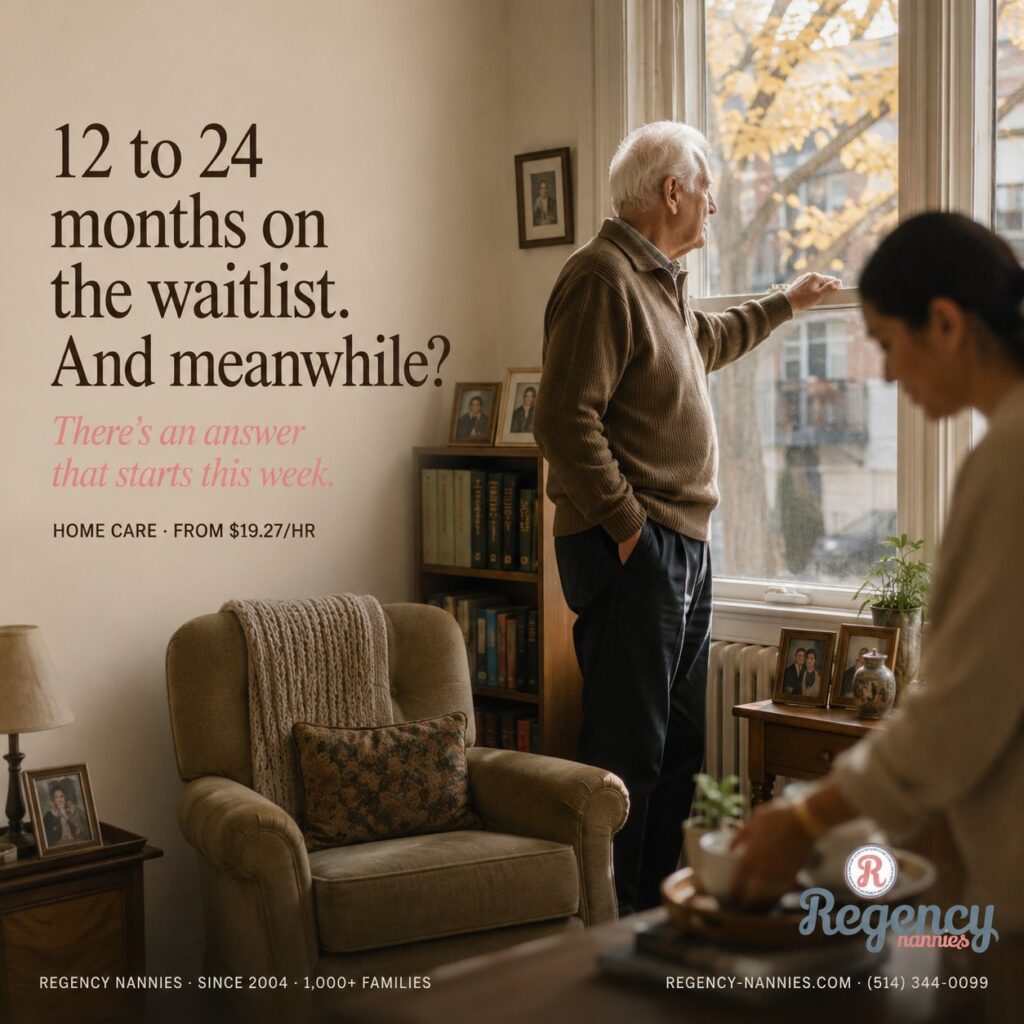
- A public CHSLD — roughly $1,950 a month for a private room, with the contribution adjusted to income. But admission depends on a significant loss of autonomy, and the wait commonly runs 12 to 24 months.
That wait is the blind spot in every family plan we see. A CHSLD bed is not reserved in advance like a hotel room. It is requested at the moment things tip — which is exactly the moment you cannot wait two years.
The geographic barrier and the exception that lifts it
Bringing in a live-in caregiver from abroad goes through the Temporary Foreign Worker Program. Across Quebec, that stream is open to eligible families. In certain cities where the local unemployment rate exceeds a regulatory threshold, a restriction applies — and many families stop there, convinced the door is shut.
It is not. When someone in the household has a documented medical condition — and age-related loss of autonomy is one — a medical exception can lift that geographic restriction. It is assessed case by case, on documentation, and nobody serious will guarantee it to you over the phone. But in elder-care files it is almost always worth examining.
This is also why the file is a legal matter before it is a recruitment matter. A poorly drafted job offer or an incomplete proof can sink an application after months of waiting. Regency Nannies is led by a lawyer, a member of the Barreau du Québec, and backed by an in-house legal team: the people who build your file are the people who defend it.
The real timeline for home care for an elderly parent from abroad
Count 8 to 9 months between the first call and the arrival. Labour Market Impact Assessment, work permit, medical exams, biometrics, settling in: each stage has its own delay and none of them can be bought faster.
Which means something simple. A family starting today is looking at a spring arrival. A family waiting for the next incident — the fall, the hospitalization, the call from the CLSC — will start the file under pressure, with no room to manoeuvre. If the need is immediate, a local caregiver can bridge the gap.
Where to start
With a twenty-minute conversation. We look at your parent’s situation, their region, their level of autonomy, and we tell you plainly which programs apply, what home care for an elderly parent would cost in their case, and whether our solution is the right one for you. We routinely point families elsewhere.
The full programme is set out on our elderly caregiver page. Since 2004, more than 1,000 Quebec families have trusted us.
Run the numbers before you decide
Free, itemized estimate with no commitment, including the support programs that apply to your parent’s situation.
Request a free estimate or call us at (514) 344-0099, Monday to Friday, 9 a.m. to 5 p.m.