



The CLSC comes twice a week, for an hour. The rest of the time, it’s you.
That is usually when people start searching for a private caregiver at home. Your mother can no longer bathe on her own, your father gets up at night and you are afraid he will fall, and you cannot be there every day. You want someone trained and reliable who comes to their home. Before comparing prices, it helps to know exactly what you are paying for.
Private caregiver at home: what she does
In Quebec, a patient attendant (préposée aux bénéficiaires) is trained through an 870-hour vocational diploma in institutional and home care assistance. At home, the work comes down to three things: helping, watching over, and keeping company.
- Daily care: washing, bathing, dressing, help with the toilet, transfers from bed to chair.
- Running the home: meals, dishes, laundry, light housekeeping.
- Safety: a presence at night, moving around the house, noticing the signs the family or the doctor should hear about.
- Company: conversation, outings, appointments. It is what seniors who live alone miss the most.
What she does not do
A caregiver is not a nurse. She can hand your parent medication already prepared in a pill organizer and check that it is taken. She does not prepare medication, change a dose or provide nursing care. Some specific care can be taught to her by a nurse, within the framework set by law. Everything else stays with the CLSC and the doctor.
That is good news, not a limitation: in most families, what is missing is not medical care. It is someone at home, at the right time.
What is missing is almost never medical care. It is someone at home, at the right time.
Three ways to get a private caregiver at home
1. CLSC home support. This is the first door, and it is free. A worker assesses your parent’s needs and assigns service hours. Since January 2026, the former chèque emploi-service is called the home autonomy allowance (page in French): on the CLSC’s recommendation, it lets you hire the person who comes to help yourself. The limit is the hours: they follow the assessment, and rarely cover every day.
2. A private agency, by the hour. It is flexible and fast: someone can start next week. The hourly rate includes the caregiver’s wage and the agency’s margin. For a few hours a day, it is often the right choice. For 40 hours a week or more, the bill climbs quickly, and the person who comes sometimes changes from one week to the next.
3. A full-time senior caregiver from abroad. This is the option we support. Your family becomes the employer of a caregiver who works full time with your parent, always the same person. She can live in if she wishes. The timeline is 8 to 9 months from the first call to her arrival, so it pays to start before a crisis.
The three can be combined. Many families keep their CLSC hours, use an agency as a bridge, and prepare a full-time caregiver’s arrival in parallel.
Private caregiver at home: what it really costs
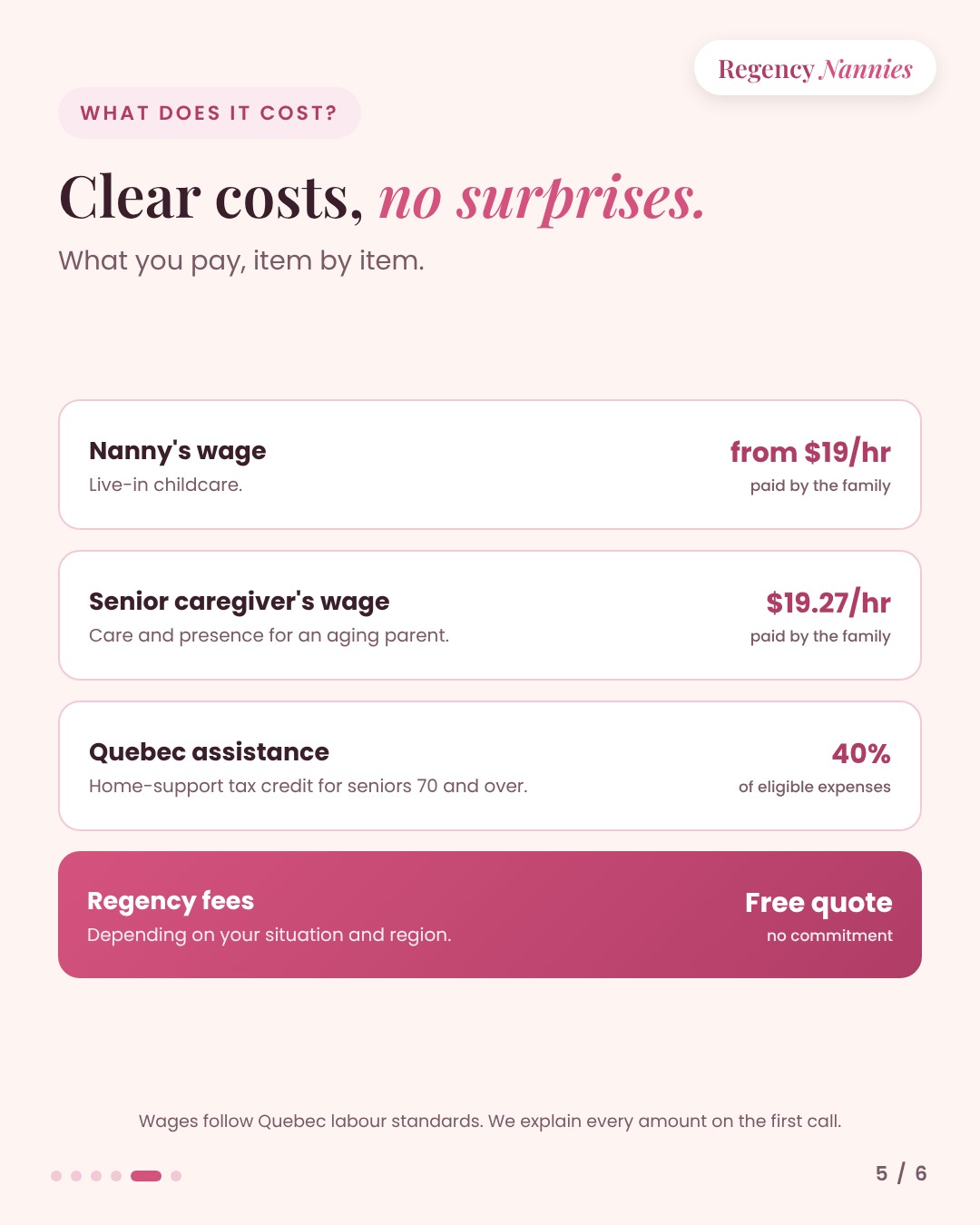
For a senior caregiver from abroad, the starting point is her wage: $19.27 an hour. Regency’s fees vary with your situation and are quoted free of charge. We do not publish a total price: no two families ever have exactly the same need.
Quebec reimburses a good part of it. For a parent aged 70 or over, the home-support tax credit reimburses 40% of eligible expenses in 2026, even if they pay no tax. We walk through the calculation in our article on the real cost of home care for an elderly parent.
In Montreal, the eligibility question
In Montreal, Laval, Longueuil or Gatineau, the federal program is restricted for low-wage positions, but the medical exception reopens it: when a caregiver comes to look after a person with medical needs, such as an aging parent losing independence, the application remains eligible for processing, with a physician’s note. We explain it in our article on the LMIA freeze in Montreal. In the regions, in Quebec City, Sherbrooke or Saguenay, the program is open with no medical condition: see the regions’ advantage.
The file is prepared with you by our founder, a lawyer and member of the Barreau du Québec. No government application is approved in advance, and nobody serious can guarantee its outcome. What we do is build a solid file.
Where to start
- Ask your parent’s CLSC for an assessment, if it has not been done. It is free, and it is the door to the home autonomy allowance.
- Over one week, note the moments when nobody is there: mornings, nights, weekends. That is where the real need is.
- Count the hours. Under 20 hours a week: the CLSC and an agency are often enough. Over 40 hours: a full-time caregiver becomes the most stable option.
- If a CHSLD place has been requested, do not stay without a plan during the wait: we cover it in our article on the CHSLD waiting list.
Not sure which option suits your parent? Thirty minutes on the phone to go over it all: their needs, the hours, the Quebec support they are entitled to. No commitment, and we will tell you honestly if another solution suits them better. All the details are also on our elderly caregiver page.
Talk about my parent’s situation or call us at (514) 344-0099, Monday to Friday, 9 a.m. to 5 p.m.