


“They told me it was impossible in Montreal.”
We hear that sentence almost every week. A daughter looking for someone to live with her mother. A couple whose autistic child has stopped sleeping. A father in treatment who can no longer look after his children alone. Someone told them about the LMIA freeze in Montreal, and they closed the file.
They are half right. And the missing half is exactly the part that applies to them.
The LMIA freeze in Montreal, explained simply
Since September 2024, the federal government has refused to process LMIA applications for low-wage positions when the work location is in a metropolitan area where unemployment is 6% or higher. A live-in caregiver paid from $19 an hour falls into that category.
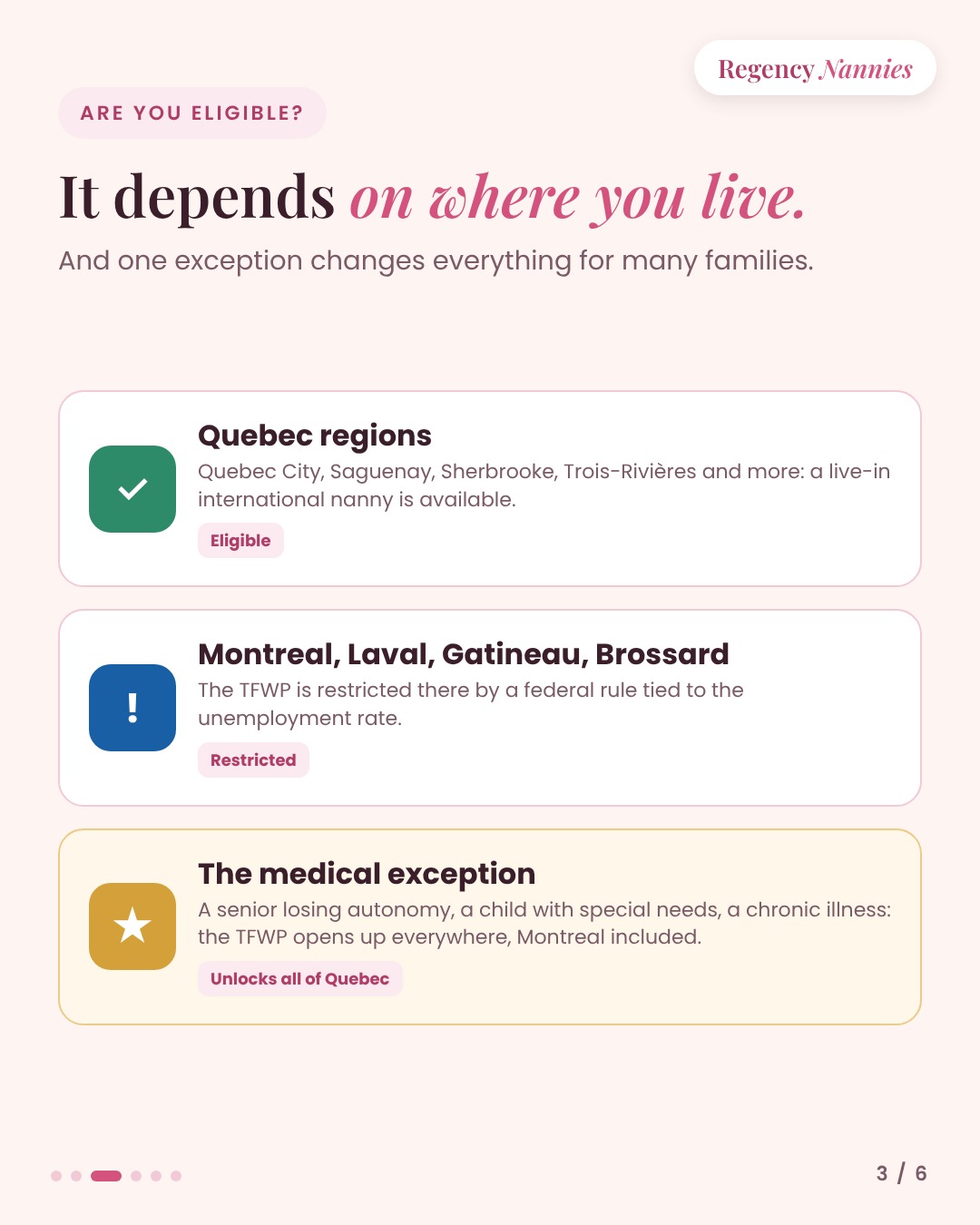
For applications submitted from October 9, 2026, to January 7, 2027, the Montreal metropolitan area — which includes Laval and Brossard — stands at 7.2% unemployment. The Ottawa-Gatineau area is also on the list. Quebec separately obtained a freeze specific to the Montreal and Laval regions, in effect until December 31, 2026. The federal list is reviewed every quarter, so a city can move on or off it.
Elsewhere in Quebec — Quebec City, Saguenay, Sherbrooke, Trois-Rivières or Drummondville — the program remains open for the same period.
What the LMIA freeze in Montreal does not block
The rule itself provides for two situations for in-home caregiver positions with a family in Quebec. The application remains eligible for processing if the caregiver will:
- care for a person with medical needs — an aging parent losing independence, a child with autism, Down syndrome, cerebral palsy or another condition that requires continuous presence;
- care for a child whose parent cannot look after them for medical reasons.
The second case is almost always overlooked. It does not require the child to be ill. When a physician confirms that a parent’s health prevents them from caring for their child, it is the parent’s health that opens the door, and the nanny looks after perfectly healthy children.
This is what we call the medical exception. The word is accurate: it does not lift the restriction for everyone, it lifts it for these specific situations. Our live-in caregiver in Montreal page sets out the three paths available depending on your situation.
The freeze closes a door for most families. It leaves one open for the families who need it most.
The document that makes it work: the physician’s note
The exception rests on one document: a note from a physician attesting to the state of health of the person concerned — your parent, your child, or yourself. Without it, the application falls into the freeze like any other.
When the caregiver must live in, you also need to show that a live-in presence is necessary: either in the physician’s note, or with the schedule provided for this purpose in the LMIA application for people with high medical needs.
One point to keep in mind: the exception makes the application eligible for processing. It does not approve it. Every LMIA is still assessed case by case, and nobody serious can guarantee the outcome of a government application. What we can do is build a solid file. With us, it is prepared by our founder, a lawyer and member of the Barreau du Québec, together with you. The rules and the list of regions are published by Employment and Social Development Canada.
What the exception changes, and what it does not
It changes one thing: access. With a documented condition, a family in Montreal, Laval, Brossard or Gatineau can welcome a live-in caregiver from abroad, just like a family in Sherbrooke.
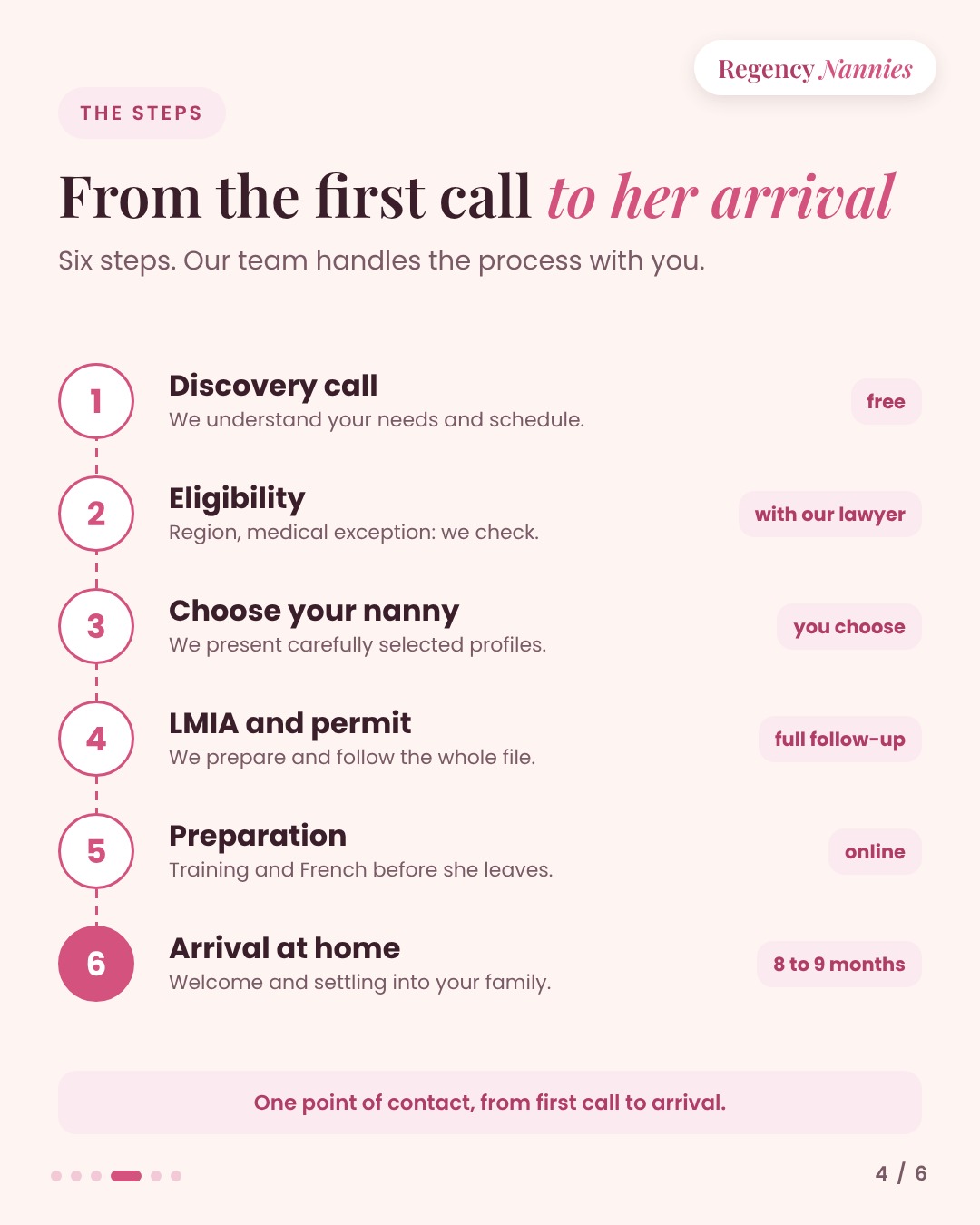
It does not change the rest. The timeline is still 8 to 9 months from the first call to arrival. You remain the employer, with a contract and conditions that meet Quebec labour standards. The candidate is prepared before she leaves, including in French. And once settled, she can become a permanent resident: it is often a presence that lasts for years.
And if no medical condition applies to your family? A European au pair, who comes through the International Experience Canada program, is not affected by the freeze. She remains available in Montreal with no condition.
The steps, from the first call to her arrival
With the medical exception, the path is the same as anywhere else in Quebec, with one difference at the eligibility step: that is where the physician’s note comes in. We walked through each step in our article on the TFWP and its real steps.
What it costs, item by item
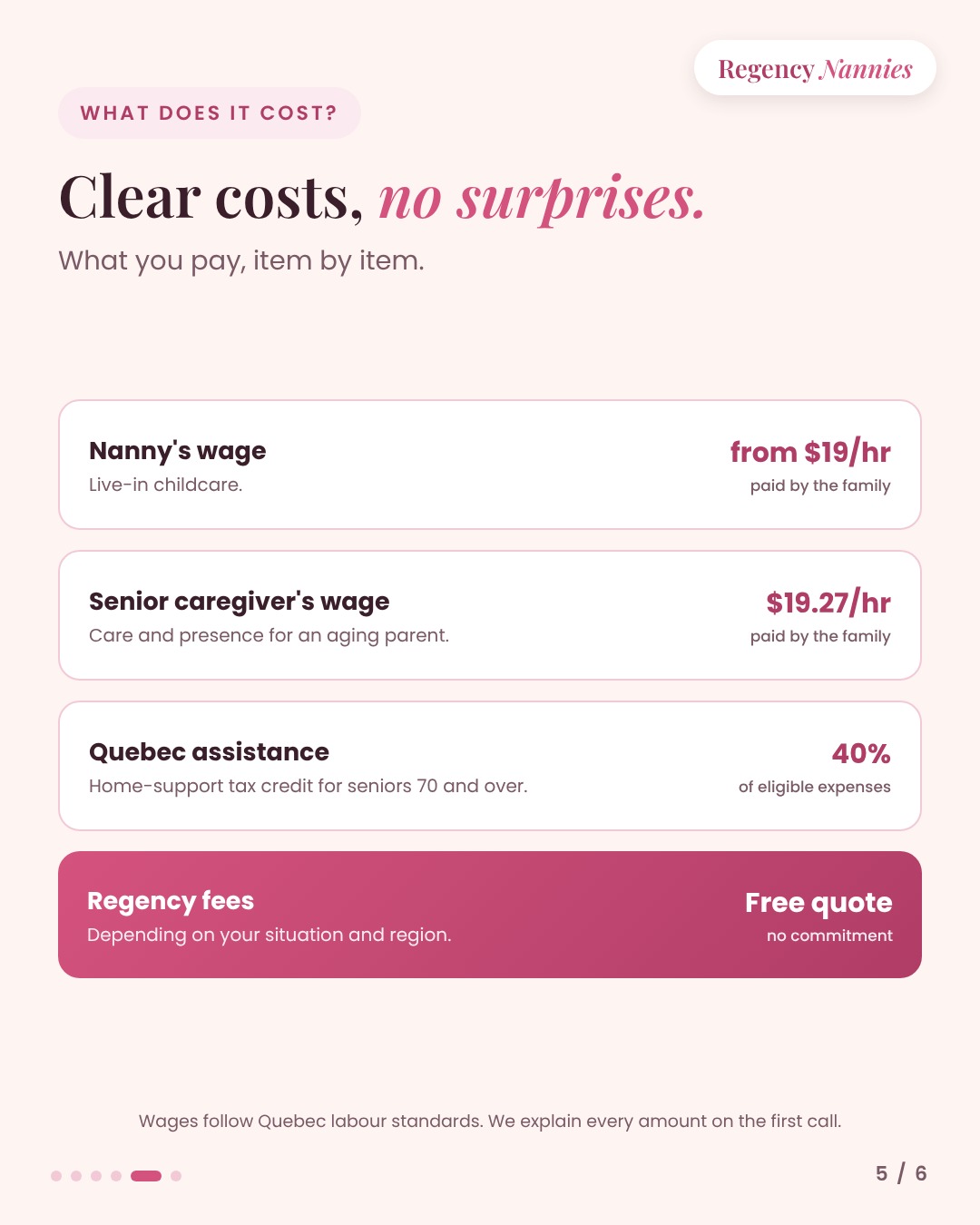
The starting point is the caregiver’s wage: from $19 an hour for a nanny, $19.27 for a senior caregiver. Regency’s fees vary with your situation and are quoted free of charge. We do not publish a total price, because no two families ever have exactly the same need.
Quebec’s support measures often reduce the bill more than people expect. For a parent aged 70 and over, the home-support tax credit reimburses 40% of eligible expenses in 2026 — see our elderly caregiver page. For a child who requires exceptional care, a supplement can reach $1,215 a month, tax-free: we explain it in our article on respite for a special needs child.
LMIA freeze in Montreal: where to start
- Identify your situation: a parent losing independence, a child with special needs, or a parent who cannot care for their child for medical reasons.
- Talk to your physician about the note. It must attest to the state of health and, if the caregiver will live with you, to the need for that presence.
- Check your address at the time of filing: the list of affected regions changes every quarter.
- Call us before you file anything. We will tell you whether the exception applies to your family and which documents to gather.
Were you told no? Let’s check together. Thirty minutes on the phone to understand your situation and see whether the medical exception applies. No commitment, and we will tell you honestly if the answer is no.
Check my eligibility or call us at (514) 344-0099, Monday to Friday, 9 a.m. to 5 p.m.